
Benjamin Crump Discusses Civil Rights
Will May
February 13, 2020
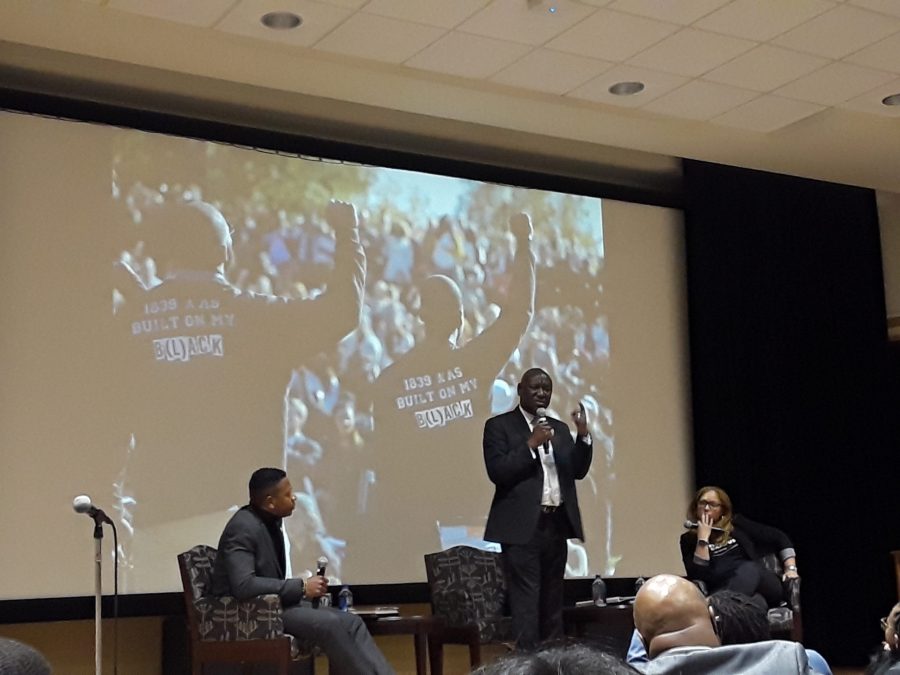
On Wednesday night, members of the university community united in Pugh auditorium for a conversation with renowned civil rights attorney Benjamin Crump. Crump is known for his involvement in many contentious, high-profile court cases in the United States, including the murders of Trayvon Martin in 2012 and Michael Brown in 2014.
The event was sponsored by the School of Law, the Intercultural Center and the university’s chapter of Alpha Phi Alpha, an African-American fraternity. The conversation included Student Government Speaker of the House Miles Middleton and Maya Angelou Presidential Chair and Professor Melissa Harris-Perry. The event began by establishing Crump’s extensive involvement in civil rights and justice, asserting that his legacy is built around the idea that the United States constitution applies to everyone, on every level of society.
Middleton said that they took the opportunity to invite Crump largely because of the university’s recent discussions regarding racial inequality. The impetus for such discourse stretches across the university’s history. From 1860, when the first endowment profited off the auction of slaves by the board of trustees, to 2019, when campus was wracked by a racist Instagram post and the resurfacing of old yearbook photos depicting students in blackface and current university deans posing in front of Confederate flags when they were students in the 1980s. As such, the administration has launched several initiatives seeking to address the issue of racism in the university’s past and present — examples of which include the President’s Commission on Race, Equity and Community and the Committee on Slavery, Race and Memory.
Middleton stated that he believed conversation to be very important in enacting progress in social justice, and that Crump was the best person to help facilitate that.
“I learned about [Crump] when I was 13 years old,” he said.
Harris-Perry helped established the context of the Trayvon Martin case to the audience by stating the basic facts: a 17-year-old African-American boy carrying groceries back to his home in Sanford, Fla., was shot and killed by George Zimmerman, a local community member of the neighborhood watch who believed Martin was acting suspicious. Zimmerman was not arrested, and only one television news outlet provided any coverage of the event at the time, largely because of the NBA All-star game taking place in Orlando.
“I cannot describe the voice coming out of the other end of the telephone,” Crump said, describing one of the initial phone calls he received from Martin’s father.
At the time, Crump assumed the police would arrest Zimmerman immediately. This was not the case. The arrest took 32 days, after social media activists and later news coverage prompted it. Crump said that he had many doubts about the possibility of success for Martin’s family, which he discussed with his law partner at the time, Daryl Parks.
“Daryl told me, ‘you know, we’re going to spend all our time, our resources and our money and they still probably won’t arrest [Zimmerman],’” Crump said. “And I remember telling Daryl, ‘you’re probably right, but if we don’t do something, who will?’”
Crump went on to discuss the context of Martin’s death among the other major instances of racial injustice throughout the history of the United States. He recalled the 1857 case Dred Scott vs. Sandford, the torture and murder of Emmett Till in 1955 in Mississippi and the shooting of Michael Brown in Ferguson, Mo., in front of 14 witnesses in broad daylight.
Crump shifted his focus again to discuss a 2015 case he was involved in: the prosecution of Daniel Holtzclaw, an Oklahoma city police officer who used the power inherent in his position to sexually assault 13 black women in a six-month period in 2014. The victims’ ages ranged from 17 to 55 years old. One of his final victims was Jannie Ligons, a 57-year-old grandmother who managed to file a police report despite her fear, igniting a chain of events that led to Holtzclaw’s arrest and eventual conviction. Crump deplored the minimal media coverage that the case received, asserting that the racial and socioeconomic demographics of the victims caused news outlets to be uninterested.
“If [the victims] weren’t black women, Nancy Grace would be crying about it every night,” he said.
Other audience members agreed that there still is inherent racial prejudice in the viewpoints of many people in the United States.
“Though I can build a computational model and use it to graphically recreate the U.S. prison system based on how it functions and how it treats black people, I can still have a conservative sit there and tell me that our experiences are subjective lies and propaganda,” junior Chi Nwakuche said. “I love that [Crump] is here, and that in moments and spaces like this we get to speak our truth.”
The conversation ended with a question-and-answer session. One query was related to how young people and students can be engaged in politics.
“Voting is one tool in the toolbox,” Harris-Perry said. “Being informed at the most local level possible is also important. It may be hard to change who the president is, but you can definitely change who your city councilmember is.”

Free Tuition Seems Unlikely For Most Medical Schools
Will May
January 16, 2020
The Association of American Medical Colleges (AAMC) estimates that 53,000 students across the United States applied to medical schools for the 2016-17 academic year. When the year started, only an approximate 40% of those students were enrolled.
These statistics should be unsurprising, as American medical schools are famous for their rigor and exclusivity. But another factor has provoked some consternation — tuition.
The AAMC estimates the average cost of attendance for private medical schools to be about $60,000 a year, while the cost for in-state students at public medical schools can be as low as $35,000. Students tend to graduate with a median debt of $200,000.
According to a national survey of 349 pre-med students conducted annually by Kaplan Test Prep, 47% opine that medical schools should offer free tuition to everyone they admit, in a manner resembling what New York University (NYU) announced for its students in 2018. Nineteen percent are in favor of a selective need-based free tuition scheme, while a mere 34% think the medical school financial aid system should remain the same. Eighty percent of the interviewed students characterized the cost of medical school as a “major prohibitive factor.”
“This number is troubling for a couple of reasons,” Jeff Koetje, Kaplan’s director of pre-health programs, said. “It suggests that a large number of qualified prospective applicants might decide to opt out of the pre-med trajectory simply because of the cost.”
Koetje also said that prohibitive costs exclude students with less financial resources from medical school, an impact that is at odds with the schools’ goals to increase the overall diversity of those they admit.
Despite the recent free-tuition direction that some schools have taken, surveys conducted by Kaplan on medical school admissions officers suggest that this will be far from the norm. A mere 4% of the submitted responses indicated plans for free tuition for all admitted over the next five to 10 years. Another 4% said they would adopt free tuition for students under a certain level of income, akin to a plan devised for Cornell’s financial aid students.
“Student tuition is part of a complex mix of finances that support the medical school effort,” Koetje said. “Some of that other funding is coming through federal or state grants. If we begin to talk about medical school tuition being free for students, it means a significant change for how medical schools support themselves and are financially sustainable.”
NYU’s ability to dole out free tuition largely stems from a donation of $100 million from Ken Langone, co-founder of Home Depot and chair of NYU Langone Health’s board of trustees.
As such, many applicants have gotten used to the idea of imminent debt.
“I was already kind of resigned to the fact that I was going to end up shelling out around a quarter of a million dollars,” said Nathan Fischer, an applicant from Marquette University.
Fischer acknowledged that the medical field is generally considered to provide sufficient financial returns to those who make their way through it, but he reiterated the importance of costs in his decision. He is primarily considering schools in his home state of Wisconsin, as well as certain private schools.
“NYU’s programs are great, so they were always on my radar,” he said. “Now it’s like I have nothing to lose. Even if I had no chance of getting in I’d still apply, because if you get in, it’s free.”
Other students shared Fischer’s sentiments.
“I think that’s why applications to NYU have skyrocketed,” said Kendall Derry, an applicant from Vanderbilt University. “It’s such a big deal and so unusual.”
Derry has already been accepted to NYU, and is waiting for other responses before making her decision. She said cost was significant in determining where to apply, as she is funding her own medical education.
“I think as long as [medical schools] have the infrastructure in place they should consider free tuition,” Derry said. “I think it’ll just take a long time for that to happen.”
Koetje recommends that pre-med students be proactive in ensuring that they are the most competitive candidates for admissions and for earning merit-based aid or scholarships.
“Pre-med students should think carefully about how they will pay for their medical education well in advance of applying,” Koetje said. “keeping in mind that it is still an excellent investment, despite the up-front costs.”
Deacon Profile: Joel Tauber
Will May
December 5, 2019

Walking back and forth along the same seven-mile stretch for 40 days seems like an unimaginable feat.
But that is exactly what filmmaker, artist and associate professor Joel Tauber is doing.
Tauber, who teaches art and film, is currently wrapping up a 40-day project dedicated to forging connections and promoting unity along the border wall in San Diego, California. His walk began on Oct. 29 and will conclude on Dec. 7.
Clad in a vintage baseball uniform, he is approaching the people he meets to share stories and play coach, many of whom he will film. This project and the resulting film will be compiled into an art project entitled Border-Ball.
Can you tell me more about the route you are taking?
I’m walking for seven miles along the border wall from the Otay Mesa Port of Entry in San Diego and then up to the Otay Mesa Detention Center and back. I’m doing this every day for 40 days through Dec. 7.
I start at the pedestrian bridge at the port of entry at noon, and I interview people there and play catch with them until 1 p.m. Then I start walking. I’m meeting people and talking to them about the border, baseball, the detention center, the wall, immigration or whatever they want to highlight. We talk mostly in Spanish, because there’s a lot of people here on their way to Mexico.
I’ve been connecting with people, and we’ve been playing catch, which is even more beautiful than I anticipated.
Why did you choose certain specifics of your project, such as the 40-day length and baseball?
Our country is very religious in many ways. I don’t practice organized religion, but I believe in ethics and spirituality. Most of my work is based around ethics and environmentalism. This is precisely because I’m not sure if those things are as central as I feel like they should be, culturally and politically. I feel like everything has an ethical dimension to it, including how we think about the border. The 40 days taps into some Bible stories — 40 days spent going up to Mount Sinai, 40 years in the desert — I wanted to reference those things without specifically talking about them to foreground that this is it. This is something that should have an ethical dimension.
In terms of baseball: I believe it contains a lot of ideals that I feel our country embodies. There are certain ideals that we may have never reached; there’s racism in baseball, for example. The United States is far from perfect, too. There’s been racism, genocide and all sorts of problems. But, there are certain things about our country that I really love. To me, America is at its most beautiful and most strong when we think about and embrace how we really have embodied the idea of diversity. Baseball to me is a dream for our country. A dream of an endless green field, where we can all live and play together. So, I’m trying to bring that kind of open-heartedness down to the border, where we’ve perhaps become more closed. This is a patriotic act, an act of citizenship. There’s things that trouble me: how we are turning refugees away, how we’re locking up so many people in detention centers. This is not how I see America. I see America as a compassionate country, a country that embraces immigration. So, I’m wearing a uniform that is blue, white and red. I’m embracing the ideals that I think our country represents.
Is that why you play catch with the people you meet?
The act of playing catch with people who are strangers to me creates a connection. We’re doing that at the border, a place where our divisions are emphasized. Playing catch can help bridge the gap between different people. It is a repetitive action. We’re trusting each other and communicating with each other. We’re in another form of dialogue.
Are you at liberty to share a story from someone you have connected with?
Very early in the project, I was walking up to the detention center. It’s this big concrete thing, and it’s surrounded by barbed wire. It brings up lots of feelings for me. My grandparents on my father’s side were survivors of the Holocaust. My grandpa’s brother died in a labor camp. So when I see a detention center with people who are locked up, it’s upsetting.
I was tired when I got up to the gate. I sat down in front of the wall, and these people in a car came up and asked me if I was okay, and if I needed any help. That generosity and compassion just felt so beautiful to me. These people didn’t know me, but they were asking if I needed help — an act of citizenship.
There was a family in the car. There was a woman inside whose brother is locked up in that detention center and has been for the last six months. And she was asking me if I needed help. I explained to her what I was doing there, and she was deeply moved. She wanted to help and participate, though they haven’t been able to get in front of the camera because they were worried about their own papers.
Have all your encounters been this affirming?
I’ve been ignored many times. I’m sure there’s people who think I’m a weird guy. It is strange to be walking around in a baseball uniform. But weirdness is something that I embrace — it means we are thinking outside convention.
But mostly, people have been very affirming. I spoke with an older man who was an amputee. He shared his story with me, and he played catch with me anyway — he leaned against the wall with his crutches. We tossed the ball close to each other, and we hugged.
Is there anything the Wake Forest community can do to support you in your endeavor?
If they know people here that would like to walk with me and toss a ball that would be wonderful. They also can help spread the word about the project on social media.
My goal here is to raise questions. We should all think about what we can do to be even more compassionate, generous and openhearted to the people around us, and to reach out to people to see if we can help them. I think that follows the spirit of what Border-Ball is.

Campus’ Indigenous Land Roots Acknowledged
Will May
November 7, 2019
On Monday evening, the denizens of Wake Forest congregated at the center of campus in Reynolda Hall for an event that was the first of its kind in the history of the university.
The event was dubbed the Indigenous Land Acknowledgment. Its purpose was to gather members of the campus community together with members of the North Carolina Tribal Nations to commemorate the indigenous heritage of the land upon which both the old and new incarnations of Wake Forest’s campus were built. This event is a part of Native American Awareness Month (NAAM) and coincided with the erection of a commemorative plaque in the courtyard outside Tribble Hall.
Jonathan A. McElderry, assistant dean of students and executive director of the Intercultural Center, said that this event was almost exactly a year in the making.
“[This acknowledgement] shows our native students that they are welcome on this campus,” he said. “It also shows the strides we are making to create a more inclusive campus. This plaque represents all of the hard work that so many people around this campus do to make sure that all our students feel welcome, and it is a symbol for our native students.”
The land acknowledgment is part of a larger effort to increase the inclusivity of the university’s community, especially in light of events such as the threatening emails that were sent to a number of offices and academic departments in September. Initiatives like these include the President’s Commission established by President Nathan Hatch and The Slavery, Race and Memory Project.
The event was sponsored by several university offices: the Intercultural Center, the Native American Student Association (NASA), the Department for the Study of Religions, the American Ethnic Studies Program, the Department of Anthropology, the Office of the President, the Office of the Provost, Division of Campus Life, the Dean of Students Office and the Office of Diversity & Inclusion.
The event began with Ray Silva of the Pueblo/Navajo nation, who performed an honoring song: setting a tempo with his hand drum, he vocalized powerfully in the language of his people. He was soon joined by Brenda Silva of the Haliwa-Saponi Indian Tribe to perform a healing song. Clad in ceremonial clothing, she danced.
“When she dances, she is praying for all the sick and wounded in the world today,” Silva said.
After the songs, Vice President of the Office of Diversity & Inclusion and Chief Diversity Officer José Villalba addressed the audience on the event’s purpose. He asserted the importance of acknowledging and addressing the roots of the university’s land.
“You are here at an incredibly momentous time,” he said.
This was followed by an address from Roo George-Warren of the Catawba Indian Nation, who described the vast swath of knowledge inherent in the university’s land heritage. He described how important honoring the land was to his ancestors and implored the audience to be mindful of their relationship with the land.
Professor Ulrike Wiethas of the Department for the Study of Religions then took to the stage to further reinforce the event’s theme of mindfulness. She implored the audience members to take a look at their neighbors, before providing context on the history of land acknowledgement, which she said was a timeless indigenous protocol that honored the stewardship between indigenous people and the land upon which they lived. She also asserted that the damage done by colonialism must not be ignored and that its wounding power still lives on today, concluding that the responsibility for working to heal those wounds falls on everyone.
Matthew Tooni of the Eastern Band of Cherokee Indians also provided valuable pieces of his culture. He performed an extremely quick and precise flute solo for the audience and also shared the Cherokee earth creation story later on in the evening.
Freshman Mahlea Hunt gave a thought-provoking testimonial to the room. She discussed her personal native heritage, which is rooted in the Lumbee Tribe of North Carolina, and credited the value of respect that was instilled in her from an early age. She ended her part with a moving performance of the song “Amazing Grace” in her indigenous language, accompanying herself with a hand drum.
“I was not aware of the land heritage, but as soon as I came [to Wake Forest,] the Intercultural Center educated me,” Hunt said. “I really got interested in acknowledging indigenuous lands, so I got very involved with them to be a part of this.”
Savannah Baber, who is also a member of the Lumbee Tribe and an alumnus from the class of 2019, gave a few remarks. McElderry credits her for the event’s conception in the spring of 2019. She said that students who are uninformed on the heritage of their school should look to academic departments and their indigenous peers to learn more. She also commented on the newness of the administration’s acknowledgement of Wake Forest’s land heritage.
“I think this is a wonderful first step. I definitely think that [the Wake Forest administration’s] intention is to learn more and to do more,” she said. “I certainly think they are moving in the right direction.”
President Hatch also commented on the event’s importance to the Old Gold & Black.
“It is important to come to terms with history, particularly when there are descendants or heirs still living,” he said. “This is one more way that we can authentically come to terms with the ‘crooked timber’ of the past.”
The event was concluded by McElderry, who thanked both the audience and the sponsoring departments. He also reminded everyone that this event is merely the first in a month-long series of events honoring Native Americans. The next event is a NAAM pop-up event from the Harvest Table Culinary Group in the Pit from 11 a.m. to 2 p.m. on Friday, Nov. 8, featuring authentic Native American cuisine.

LSAT Undergoes Drastic Change
Will May
September 26, 2019
Wake Forest’s campus was nearly deserted at 8 a.m. last Saturday morning, with one exception: a long procession of students was shuffling into the Wake Forest University School of Law to face an approximately three-hour trial with the power to make or break all of their hopes and dreams. They came to take the Law School Admission Test, also known as the LSAT.
This was no ordinary day of standardized testing. These students were among the second group of law school candidates that had been subjected to the most drastic change the exam had undergone in over 25 years. Once a pencil-and-paper affair, the test has now been completely converted to a digital format: on a tablet, complete with a stylus.
“It’s important to note that the content of the exam is not changing a lick,” said Jeff Thomas, executive director of admissions programs for Kaplan Test Prep. “The content is the same, the length of the test is the same, the number of questions is the same and the scoring methods are the same. Students don’t have to learn different skills than they used to when preparing for the LSAT.”
Thomas clarified that many ubiquitous standardized admissions tests, such as the Medical College Admissions Test (MCAT) and the Graduate Records Examinations (GRE), transitioned to a digital format years before the LSAT. He cited a number of benefits from digitization, including greater efficiency, a greater number of testing days and a shorter wait for scores. However, the LSAT requires more physical engagement with its material, such as highlighting. Because of this challenge, the Law School Admission Council, also known as LSAC, had been working on the transition for over five years before finally going forward with it.
According to Russell Shafer, senior communications manager at Kaplan Test Prep, ample material was provided to help students adjust to the new format. This includes multiple digital practice tests on the LSAC website and an e-book put together by Kaplan.
The first administration of the LSAT’s new form was on July 15, 2019. Those who took the exam on this date did not know if they would be using the new format; approximately half received the digital test and the other half received a traditional one with a pencil and paper. Thomas said that a good number of students made their thoughts on the change heard.
“We’ve asked all of the students who have sat through the digital tests both in July and September to give us feedback on the experience and let us know if there are any unanticipated challenges,” he said. “The majority of our students have cited that they approve of the new format and it was easier to utilize than they anticipated, which is great.”
Seventeen percent of students to use the digital format rated their experience as “very good,” while 36% rated it as “good.” Thomas clarified that some students had responded that they preferred using paper and a pencil to complete exams, and that others had struggled to use the stylus.
“At first, I was not happy about it being digital just because I learn better on paper,” said senior Dylan Dobson. “But actually once I started practicing on a digital format it became a lot quicker and more efficient, so I actually like it a lot more now.”
Dobson has taken the LSAT in both formats since the change was first implemented. She said that the differing formats did little to affect her experience taking the test. She also expressed strong enthusiasm for the stylus, an instrument that was dually effective as a ball-point pen, which she was allowed to keep. Not every student was this enthusiastic, however.
“I would prefer to take it on paper,” said senior Ren Schmitt, who took the exam on Saturday. “The digital had some upsides, primarily the timer in the corner of the screen and not having to bubble answers on a scantron, but I find reading on screens to be more taxing than reading on paper.”
Schmitt also said that he felt the stylus could have been easier to use. However, he also said that despite his preference, he felt that the impact on his score was negligible. He also said that he made sure to take advantage of the provided preparation materials. However, despite the care taken by the test-makers to maximize success for all involved, technology has not proven infallible.
“The computer crashed right before we started, [on Saturday]” said Dobson, “so we couldn’t even start the test until everyone re-registered their tablets into the system. It was stressful, although it ended up being a pretty quick delay, only 20 to 30 minutes.”
Thomas said that LSAC was unlikely to make any more immense changes to the test in the near future, but that tweaks to the format would be implemented as technology improves.

 Will May